


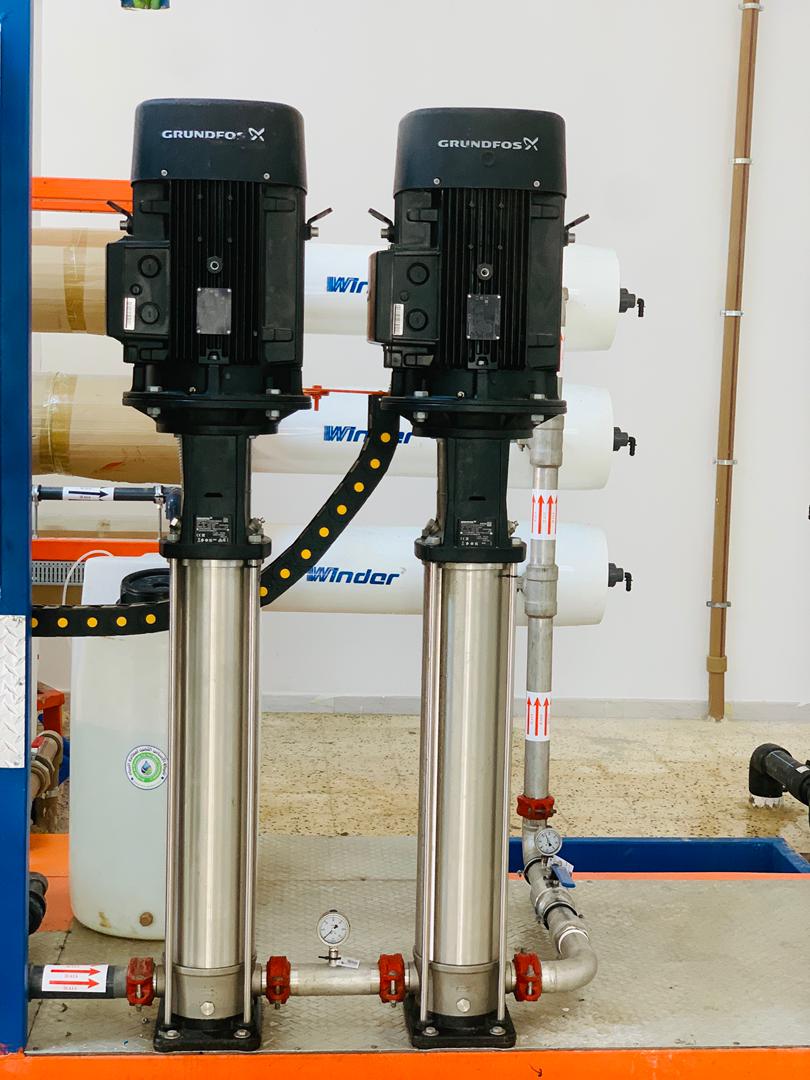
ALS builds its desalination and treatment plants with components from specific international brands for each function — from membranes and pumps to control panels and piping.
Why does the component brand matter in a desalination plant?
A desalination plant is not a set of separate parts — it is an integrated system, and any weak component (a pump, a valve, a control panel) quickly becomes a failure point that stops the whole plant. That is why ALS specifies fixed components for each key function in the plant, instead of relying on the cheapest alternative available on the market at the time of manufacture.
Three criteria govern the choice of each brand:
- Operational reliability under Libyan power-supply and water-quality conditions
- Availability of spare parts and service locally and regionally over the long term
- Proven track record in similar desalination and treatment projects
Which reverse osmosis membranes are used, and why?
ALS uses LG Chem RO membranes, with the membrane type selected for the water source: seawater (SW) membranes for high-salinity projects and brackish-water (BW) membranes for well water. These are spiral-wound thin-film composite (TFC) membranes, selected according to the required salt rejection and productivity of each project.
How do membrane types differ by water source?
| Source type | Membrane class | Typical operating pressure |
|---|---|---|
| Seawater | SW — high salt rejection | High (55–80 bar) |
| Low- to medium-salinity wells (brackish) | BW | Medium (8–20 bar) |
Which mechanical and electrical components are specified?
The table below summarises the other key components in ALS plants:
| Component | Brand | Role in the plant |
|---|---|---|
| High-pressure pumps | Grundfos (Denmark) | Driving water through the RO membranes at the required pressure, continuously and with high energy efficiency |
| Automatic control valves | Runxin | Controlling backwash cycles for sand filters and the pre-treatment stage |
| Chemical dosing pumps | Seko (Italy) | Accurate dosing of antiscalant and chlorine at stable, calibratable rates |
| Panels and electrical control components | Schneider Electric (France) | Motor protection, automatic operation control and protection against supply fluctuations |
| Process piping (PPR) | Polymat (Turkey) | Pressure- and temperature-resistant connections between plant stages |
| PVC pipes and fittings | Pimtaş (Turkey) | Feed and drain lines at low to medium operating pressures |
What does this mean for plant life and maintenance cost?
Choosing components from internationally recognised brands has a direct, tangible effect:
- Longer service life — components designed for continuous operation without repeated failures
- Spare-parts availability — shorter downtime when a part needs replacing
- Higher energy efficiency — especially in pumps, which directly lowers electrical operating cost
- Standardised technical base — makes it easier for maintenance teams to diagnose and fix faults quickly
Frequently asked questions
Are the same brands used in every ALS project?
This is the default specification for most projects. In some cases, depending on the client’s request or the nature of the project, other alternatives may be used by prior agreement.
Are spare parts for these components available in Libya?
Yes — this is one of the reasons these brands were chosen: to ensure continuous operation and a fast response when any component needs service or replacement.
What is the practical difference between SW and BW membranes?
SW (seawater) membranes are designed for much higher operating pressures and stronger salt rejection, while BW (brackish-water) membranes operate at lower pressures and suit well water that is less saline than seawater.
Can the brands be adapted to a project budget?
Alternatives with different specifications can be discussed according to each project’s budget and requirements — contact our technical team to review the right options for your case.
Want details of the components for your next project?
The ALS technical team is ready to discuss detailed specifications for your project’s needs. WhatsApp: +218 930 778 375 · Phone: +218 918 444 575
Prepared by the technical team of Al-Asas Al-Thameen for Water Treatment (ALS) — founded 2013, Libya.