


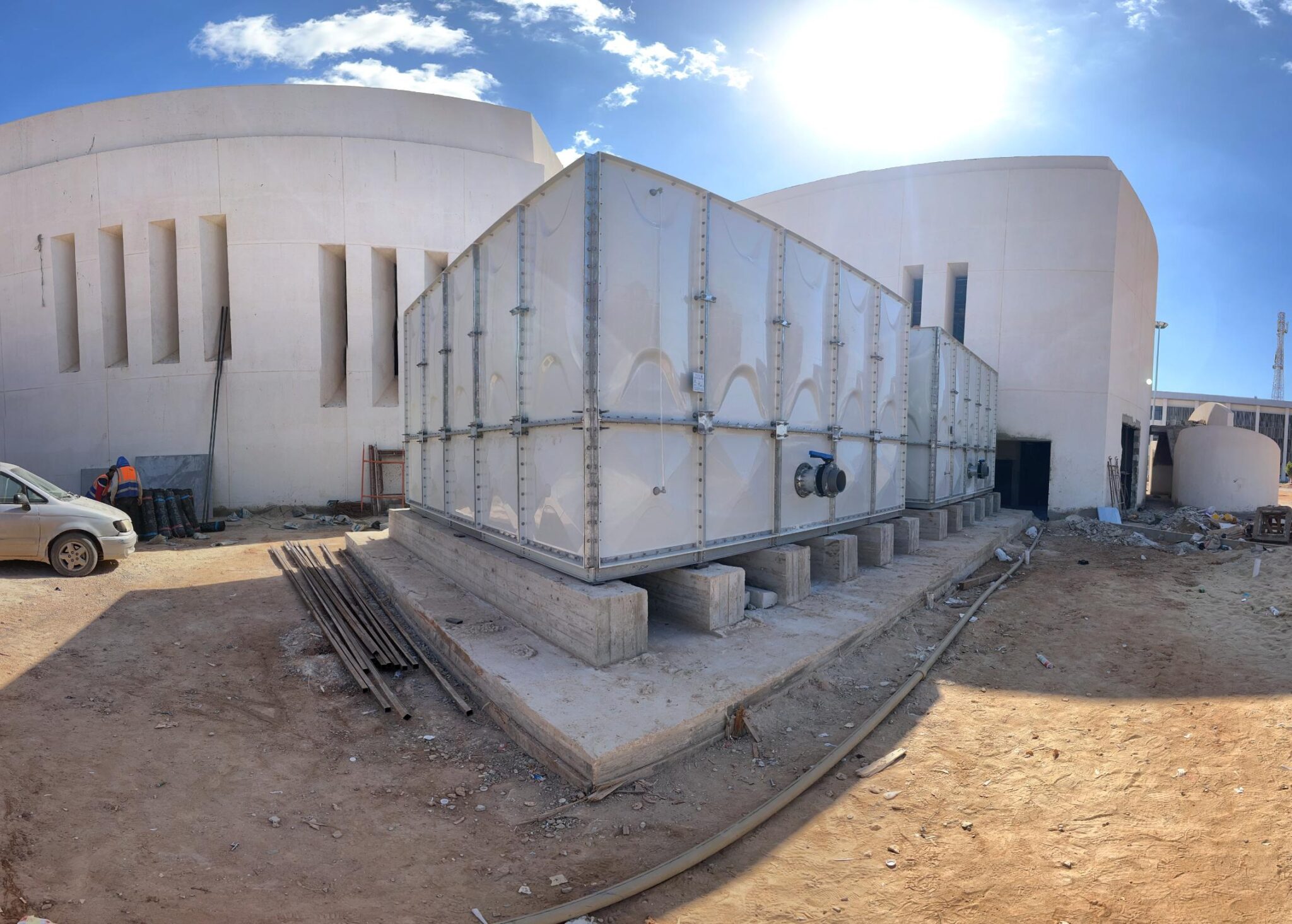
A storage tank is the last point that controls water quality before it reaches the user. Here is what a GRP tank delivers, and why we used it for the Faculties of Law and Arts.
What did we deliver at the University of Benghazi?
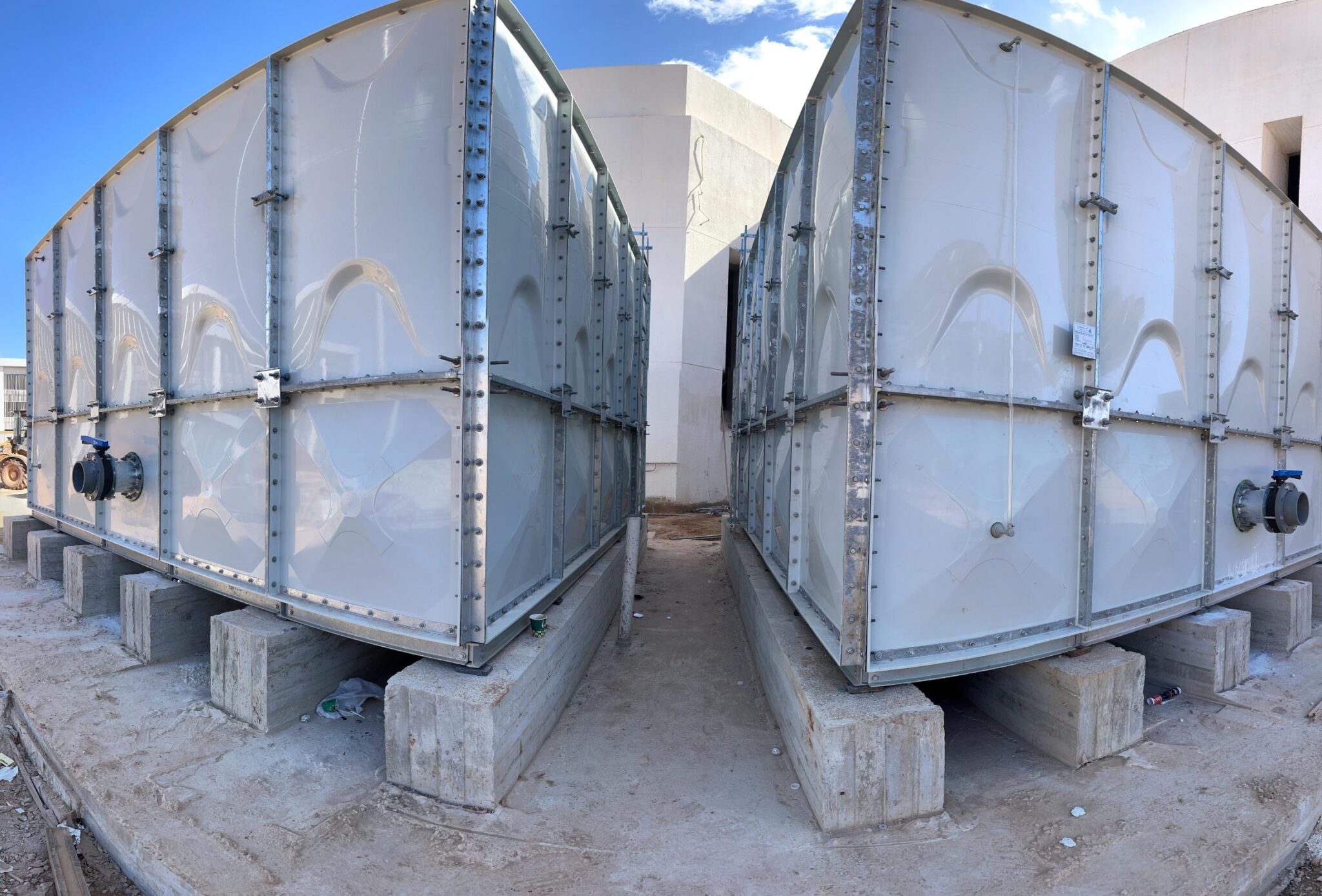
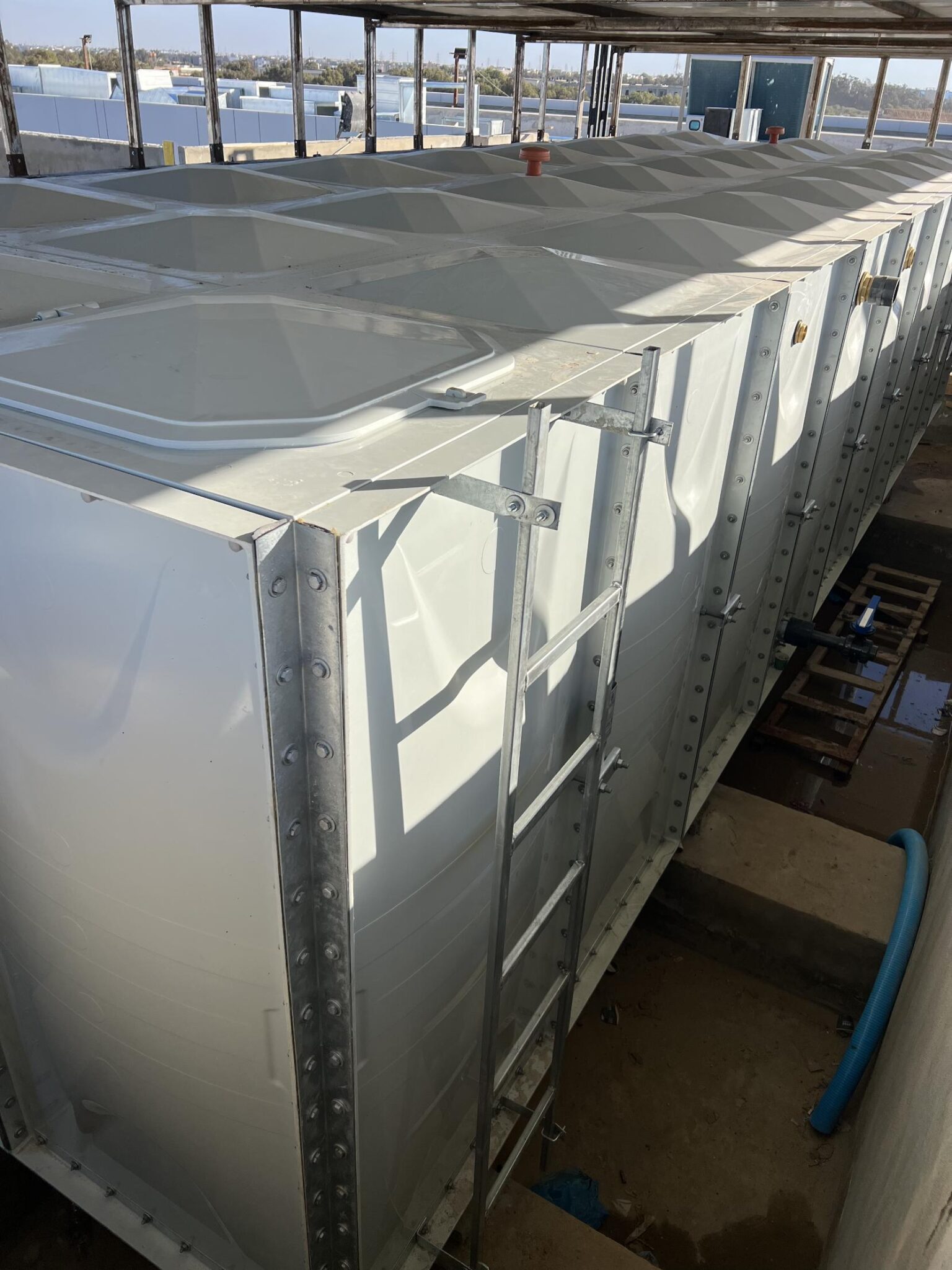
We supplied and assembled five sectional GRP tanks for the Faculties of Law and Arts at the University of Benghazi: two 75 m³ tanks, one 54 m³ tank and two 6 m³ tanks. Their locations ranged from concrete plinths to a building roof and a steel base inside a building. This is exactly what a sectional system allows: panels arrive flat and the tank is built where it is needed.
Why does no light enter a GRP tank?
Algae need light. If a tank wall lets sunlight through and the water is warm and still, green growth starts on the walls and in the water, odour and taste change, and the organic load feeding bacteria rises.
GRP panels used for drinking-water storage are opaque, the roof is made of the same panels, and the manhole has a closed cover. Not enough light remains inside to sustain that cycle. This matters in Libya, where many tanks stand on roofs in direct sun all year.
Does a GRP tank hold water temperature?
To some extent, yes. The reason is the material: GRP conducts heat far less than steel, so the wall does not pass solar and ambient heat into the water at the same rate. Typical approximate values:
Be realistic, though: a standard panel slows heating but does not stop it. What changes is the day-night swing and how fast water warms in summer; water will not stay cold indefinitely. Since cooler water also slows bacterial growth, this benefit supports hygiene too. Where temperature is a project requirement, foam-insulated panels are available and are specified at design stage, ideally with shading.
Why is GRP tank maintenance easier?
Maintaining a steel tank is a fight against rust and coatings; a concrete tank, a fight against cracks and leaks. GRP does not rust and needs no paint or peeling inner lining. What remains is straightforward:
Easy access
A covered manhole, an internal ladder where needed, and service clearance around the tank.
Drain and wash
A drain nozzle, and a smooth surface that releases sediment faster.
Local repair
Panels are bolted, so a damaged panel or gasket can be addressed without replacing the tank.
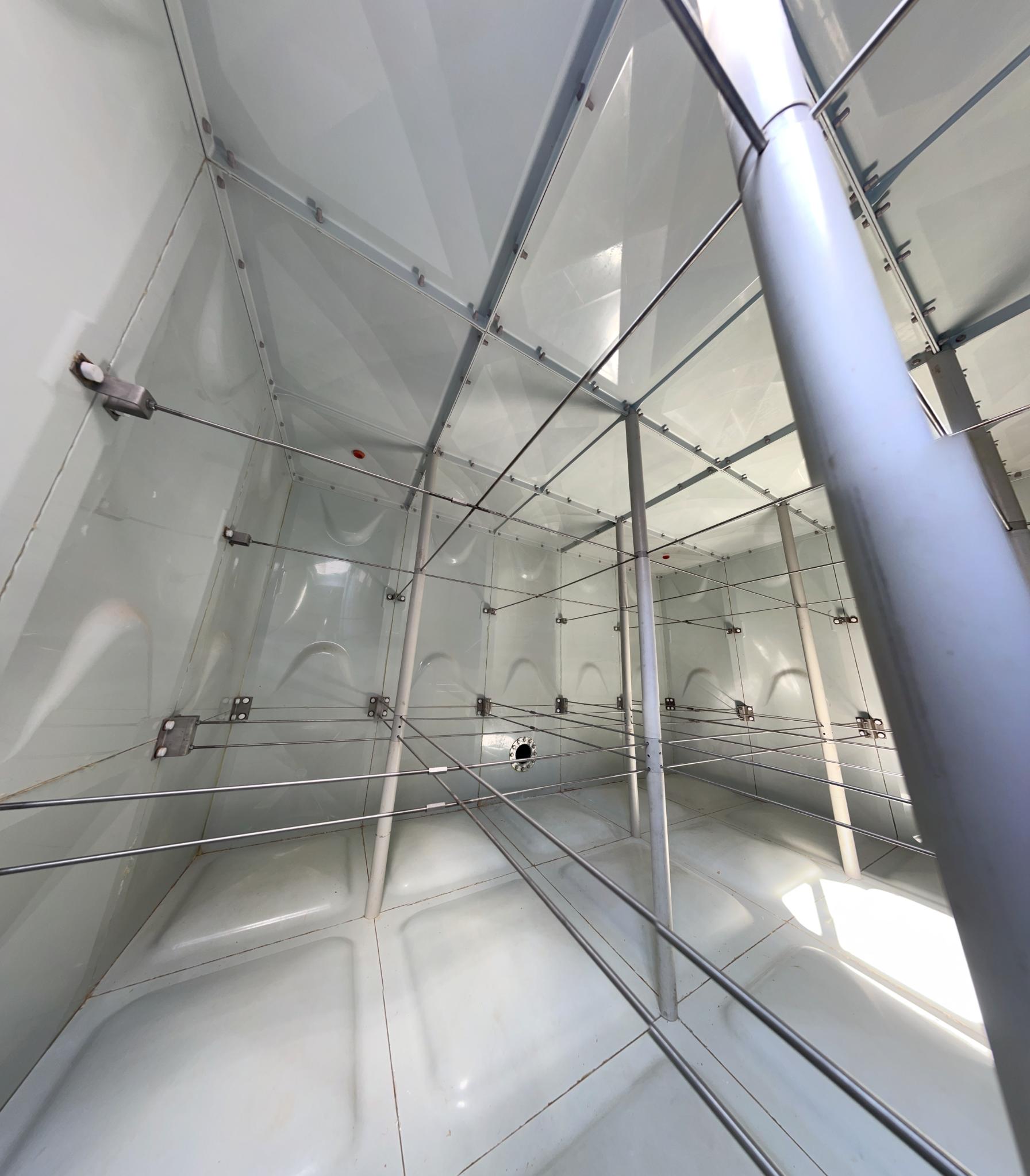
The tank can also be enlarged by adding panels if the foundation can carry the new capacity. Materials and sizes are on our GRP tank specifications page, and after-installation work is part of our services and maintenance contracts.
Why are there fewer microbial niches in a GRP tank?
Bacteria need somewhere to settle. Cracks, pores, rust layers and sediment all let biofilm take hold and shield it from residual chlorine.
The inner surface of pressed GRP panels is smooth and non-porous, so it offers fewer such places. Three more factors help: no rust builds up, no light feeds algae, and the tank is closed, with insect-proof vents. Our panels also comply with drinking-water contact standards such as BS 6920 and WRAS approval, with certificates issued in the name of the producing factory.
How does a GRP tank compare with other tanks?
| Criterion | Sectional GRP | Steel | Concrete | Light-coloured plastic |
|---|---|---|---|---|
| Light entry | Opaque | Opaque | Opaque | May pass light |
| Heat transfer | Low | High | Medium, with high thermal mass | Low |
| Rust and corrosion | No rust | Needs protection | Depends on cracks and rebar | No rust |
| Inner surface | Smooth | Depends on lining | Porous unless lined | Smooth |
| Capacity and site access | Panels fit narrow doors | Needs welding or crane | Cast in place | Limited sizes |
No tank suits every case. GRP needs an accurately level foundation under the joint lines, and proper installation so the gaskets seal. It is usually the strongest option for medium to large drinking-water storage, for hard-to-reach sites, and as a product tank for well-water desalination and drinking-water plants.
Among the first and longest-established in Libya
We have supplied and installed GRP tanks in Libya since the early days of the technology in the local market, so we treat the tank as part of the water system: capacity, foundation, installation, testing, disinfection and operation. See more in our projects.
Frequently asked questions
Is a GRP tank suitable for drinking water?
Yes, when the panels, gaskets and wetted parts are approved for that use. Ask for the factory certificates in the project file rather than accepting the word “fiberglass”.
Will the water stay cold in summer?
That cannot be promised. A standard panel only slows heat transfer. If temperature matters, choose insulated panels, shade the tank and calculate how long water stays inside.
How often should the tank be cleaned?
It depends on the water and the use. For drinking-water tanks, inspection, cleaning and disinfection at least once a year is typical, and after any contamination or long shutdown.
Can it be installed on a building roof?
Yes, as we did at the University of Benghazi, provided the roof is structurally checked for the water load and a suitable base is prepared first.
Need a tank sized for your project?
Send us the capacity, the available space and the intended use, and we will recommend the right size and foundation.
Prepared by the technical team at Al-Asas Al-Thameen for Water Treatment (ALS) — a Libyan manufacturer of water treatment chemicals and desalination plants since 2013.